← All Posts
Investing
IPO Analysis
Biblical Stewardship
The SpaceX IPO:
What Faithful Stewards Need to Know
Exciting technology. Complex financials. A significant valuation gap. Before you decide, here is the honest breakdown good stewardship requires.
W
William Snodgrass, CFP®
Founder & Financial Advisor · Matt25 Capital · June 2026
Clients are asking. Their adult children are texting them links. The financial media is treating it as a generational moment. The SpaceX IPO is, without question, one of the most anticipated market events in recent memory — and the excitement is not irrational.
But excitement and analysis are two different things. As your fiduciary advisor, my job isn't to match the enthusiasm of the headline — it's to make sure you understand what you're actually buying, what the risks are, and how this decision fits — or doesn't fit — your long-term financial plan. That's what this piece is about.
What SpaceX Actually Is — and What Changed
The SpaceX many people think they're buying — the rocket company with a dominant launch market and a cash-generating satellite internet business — is not quite the company being offered in this IPO.
In early 2026, SpaceX merged with xAI, Elon Musk's artificial intelligence company. That transaction fundamentally changed the financial profile of the combined entity. Starlink, SpaceX's satellite internet division, is a genuine business generating real operating profit. xAI is an early-stage AI company burning significant capital. The merger combined them into one offering.
Understanding that distinction is not a minor detail. It is the central fact of the investment.
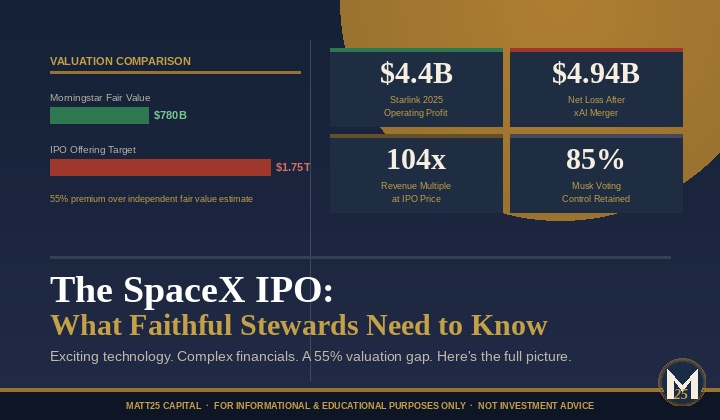
Starlink 2025 Operating Profit
$4.4B
Genuine, recurring cash-generating business with dominant market position in satellite internet
Combined Net Loss After xAI Merger
$4.94B
xAI's cash burn more than offsets Starlink's profit — transforming the overall entity's bottom line
Revenue Multiple at IPO Price
~104x
Price-to-revenue at the $1.75T offering target — one of the highest multiples for any large-cap offering in recent history
Musk Voting Control Retained
85%
Dual-class share structure means minority shareholders cannot meaningfully influence governance decisions
The Valuation Question
The IPO is targeting a valuation of approximately $1.75 trillion. Morningstar's independent analysis estimates fair value at approximately $780 billion. That is a gap of roughly 55% between what an independent analyst believes the business is worth and what IPO buyers would pay.
This does not mean the investment cannot work. It means you are paying a significant premium for expectations — not current earnings. If those expectations are met, the investment may perform well over time. If they are not, the premium paid at entry becomes a permanent headwind.
Illustrative Comparison
Morningstar Fair Value Estimate vs. IPO Offering Target
Independent analysis vs. offering price — approximate figures for educational context
Morningstar fair value estimate and IPO offering target are approximate figures cited in publicly available analyses as of the date of this publication. These figures are for informational and educational purposes only and do not constitute a recommendation to buy or sell any security. Valuations are subject to change. All investing involves risk.
What "~104x Revenue" Actually Means
A company trading at 104 times its annual revenue is priced not for what it earns today, but for what the market believes it will earn many years from now. For that price to be justified, the company must grow substantially, sustain that growth for a long time, and convert revenue into meaningful profit — all without major setbacks.
That is a possible outcome. It is not a guaranteed one. And for investors in or approaching retirement, the risk of permanent capital loss at an extreme valuation deserves careful consideration.
The Governance Reality
One aspect of this offering that receives less attention than the valuation is the governance structure. Through a dual-class share arrangement, Elon Musk retains approximately 85% of the voting power in the combined entity. Minority shareholders — which is what IPO buyers become — have essentially no ability to influence company decisions through their votes.
This is not unusual for technology companies, but it is a material fact. Decisions about capital allocation, acquisitions, executive compensation, and strategic direction rest entirely with one individual. That concentration of control is a feature that deserves to be weighed alongside the financial metrics.
A Biblical Framework for Evaluating This Decision
"The prudent see danger and take refuge,
but the simple keep going and pay the penalty."
Proverbs 22:3 (NIV)
Scripture does not tell us whether to buy a particular stock. But it gives us a framework for the spirit in which we make financial decisions. Proverbs consistently honors the person who examines, considers, and exercises caution — not the person who acts on excitement or follows the crowd.
The question for a faithful steward is not "Is SpaceX exciting?" It almost certainly is. The question is: "Does this investment — at this price, with this structure, in this position in my plan — represent wise stewardship of what God has entrusted to me?"
That answer is different for every person. For a 35-year-old with a long time horizon, a modest allocation to high-risk, high-potential investments may be entirely appropriate. For someone five years from retirement or already drawing on their portfolio, the calculus changes significantly.
Questions a Faithful Steward Should Ask Before Deciding
📋
Does this fit my plan — not just my interest?
Investment decisions should flow from a written financial plan, not from headlines. If SpaceX isn't already part of a plan built around your timeline, income needs, and risk tolerance, that's important information.
⚖️
Can I afford to be wrong?
At ~104x revenue, the margin for error is narrow. If the company underperforms expectations over the next three to five years, investors who paid the IPO price bear the full cost of that disappointment. Can your retirement plan absorb a significant loss in this position?
🕰️
What is my actual time horizon?
Speculative, high-multiple investments tend to require long time horizons to allow the underlying business to grow into its valuation. If you need this money within ten years, that time horizon may not be sufficient for an investment priced for multi-decade growth.
🎯
How much concentration am I taking on?
Many clients already have indirect exposure to SpaceX and similar companies through broad index funds. Adding a direct IPO allocation increases concentration in a single name — and concentration risk is one of the most common planning blind spots we see.
🙏
Am I making this decision from peace or from fear of missing out?
FOMO — fear of missing out — is one of the most powerful and most dangerous forces in investment decision-making. If the primary driver of interest is not wanting to miss a generational opportunity, that emotion is worth examining before acting on it.
The Bull Case Is Real. So Is the Risk.
Nothing in this analysis is a prediction that SpaceX will fail. Starlink is a genuine, profitable business. The launch dominance is real. The technological lead is substantial. The long-term opportunity in satellite internet and AI is significant.
But good stewardship means knowing both sides — the opportunity and the risk — before you decide. Excitement about the former should not crowd out honest evaluation of the latter.
That's exactly the conversation we're here for.
Wondering If This Belongs in Your Plan?
If you're considering the SpaceX IPO — or any major investment decision — let's talk through how it fits your specific situation, timeline, and goals. No obligation, no pressure.
Schedule a Conversation
Important Disclosures
The opinions voiced in this material are for general information and educational purposes only and are not intended to provide specific advice or recommendations for any individual. Nothing in this material constitutes investment, legal, or tax advice. This material does not constitute a solicitation to buy or sell any security, including shares of any initial public offering. References to specific securities, companies, or market data are for informational and educational purposes only and do not represent a recommendation. Past performance is not indicative of future results. All investing involves risk, including the potential loss of principal. Financial data and valuations referenced are approximate, drawn from publicly available sources as of the date of publication, and are subject to change. Morningstar fair value estimates are independent third-party analyses and do not represent the views of Matt25 Capital or Commonwealth Financial Network®. Any hypothetical examples used are for illustrative purposes only and do not represent actual client results. Securities and advisory services offered through Commonwealth Financial Network®, Member FINRA/SIPC, a Registered Investment Adviser. Fixed insurance products and services are separate from and not offered through Commonwealth Financial Network®. Certified Financial Planner Board of Standards Inc. (CFP Board) owns the CFP® certification mark, the CERTIFIED FINANCIAL PLANNER™ certification mark, and the CFP® (with plaque design) logo in the United States, which it authorizes use of by individuals who successfully complete CFP Board's initial and ongoing certification requirements. © 2026 Matt25 Capital. All rights reserved.