← All Posts
Market Commentary
Investing
Long-Term Planning
The Chip Selloff:
What Long-Term Investors Should Do
Semiconductor stocks dropped sharply. Retirement accounts dipped. Headlines warned of crisis. Here's what a faithful, long-term perspective actually calls for right now.
W
William Snodgrass, CFP®
Founder & Financial Advisor · Matt25 Capital · June 2026
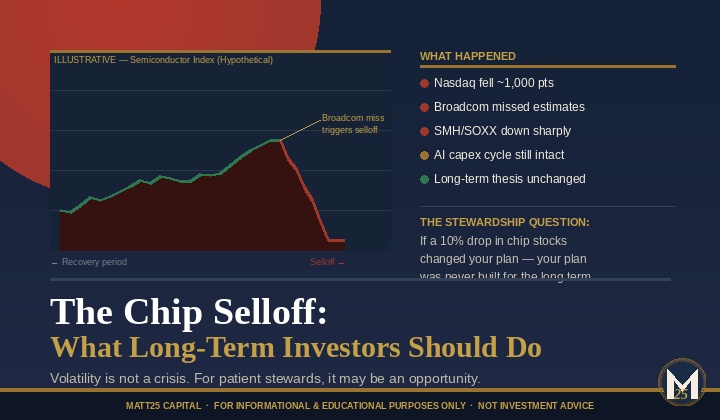
When Broadcom reported earnings that fell short of elevated expectations, the market's reaction was swift and sharp. The Nasdaq dropped significantly in a single session. Semiconductor stocks — which had carried much of the market's gains in the AI-driven rally of the past two years — fell hard. Retirement account balances dipped, and the financial media did what it always does in moments like this: it generated urgency.
If you're a long-term investor, here is the most important thing I can tell you about that day: the long-term investment thesis did not change. The short-term sentiment did.
Those are two very different things. Understanding the difference is the work of a faithful steward.
What Actually Happened — and What It Means
Broadcom Missed Elevated Estimates
Broadcom reported earnings that fell short of what analysts had priced in. In a market where AI-related stocks had been priced for near-perfection, any miss tends to ripple broadly across the sector.
AI Capital Spending Remains Intact
Microsoft, Alphabet, Amazon, and Meta have all reaffirmed substantial AI infrastructure spending plans. The fundamental demand driving semiconductor growth has not reversed.
Nasdaq Fell Sharply in One Session
The index declined nearly 1,000 points in a single trading day — one of its largest single-session drops in recent months — driven primarily by semiconductor and AI-adjacent names.
Corrections Are Normal in Growth Sectors
High-growth, high-multiple sectors routinely experience 10–20% corrections even within long-term bull markets. This is not an anomaly — it is the expected behavior of volatile asset classes.
SMH and SOXX Dropped Sharply
The major semiconductor ETFs — which many retirement portfolios hold indirectly through broad index funds — saw significant single-day losses that raised understandable concern among investors.
Long-Term Thesis Unchanged
AI infrastructure buildout, data center expansion, and the global shift toward semiconductor-intensive computing remain multi-year, structural investment themes. A single earnings miss does not invalidate a decade-long trend.
The Concentration Risk You May Not Know You Have
One of the most important — and least discussed — dynamics of the current market is how much concentration risk the average retirement portfolio carries without the investor realizing it.
If you own a broad S&P 500 index fund, the top ten holdings represent a historically elevated share of the entire index. Many of those holdings — Nvidia, Microsoft, Alphabet, Meta, Amazon — are significantly exposed to the AI and semiconductor theme. When chip stocks drop sharply, they don't just affect people who own semiconductor ETFs directly. They affect virtually everyone with meaningful equity exposure through mainstream index funds.
This is not an argument against index funds. It is an argument for understanding what you actually own — and for ensuring your overall portfolio doesn't have more technology concentration than your risk tolerance genuinely supports.
Illustrative Comparison — Hypothetical
Hypothetical Impact of a 15% Semiconductor Correction on Different Portfolio Compositions
How the same market event affects portfolios with different levels of tech/AI exposure — illustrative purposes only
Hypothetical illustration only. Does not represent any specific portfolio or client result. Actual impact varies based on individual holdings, weightings, and market conditions. This is not investment advice — consult a qualified financial professional regarding your specific situation.
A Question Worth Asking
Do you know what percentage of your retirement portfolio is directly or indirectly exposed to AI and semiconductor companies? For many investors holding broad index funds, the answer is higher than they would expect — and higher than their stated risk tolerance would suggest.
This isn't cause for alarm. It's cause for awareness. And awareness is the first step toward intentional stewardship.
What the Bible Says About Moments Like This
"Give portions to seven, yes to eight,
for you do not know what disaster may come upon the land."
Ecclesiastes 11:2 (NIV)
The author of Ecclesiastes was not writing about semiconductor ETFs. But the principle he articulated thousands of years ago is the same principle modern portfolio theory tries to formalize: we don't know what will happen, so we diversify.
Biblical wisdom does not call us to panic when markets drop, nor does it call us to chase every rally when markets rise. It calls us to build structures — in our finances as in our lives — that can weather outcomes we didn't predict. That is what a properly diversified, risk-appropriate portfolio is designed to do.
When the chip selloff happened, the clients who weathered it most calmly were not the ones who had predicted it. They were the ones who had built portfolios they didn't need to predict.
What Long-Term Investors Should Actually Do
Here is my honest guidance for the vast majority of long-term investors facing this kind of market event:
01
Do nothing — if your plan was built for this
If your portfolio was constructed with your risk tolerance, time horizon, and income needs in mind — and if that hasn't changed — then a sharp sector correction is not an event that requires a response. Reacting to volatility with portfolio changes is one of the most consistent sources of investor underperformance over time.
02
Review your actual exposure — if you haven't recently
If the selloff revealed that your portfolio's behavior surprised you — if the drop was larger than you expected or more unsettling than you're comfortable with — that's useful information. It may mean your allocation has drifted, or that it was never calibrated correctly to your actual risk tolerance.
03
Consider rebalancing — not panic-selling
For some investors, a sharp correction in a concentrated sector creates an opportunity to rebalance — trimming positions that had grown oversized relative to the plan and reinvesting in underweighted areas. This is a disciplined process that should be driven by your plan, not by headlines.
04
Examine whether you're overexposed for your stage of life
For investors within five to ten years of retirement, high concentration in volatile, high-multiple technology companies creates sequence-of-returns risk that can permanently impair retirement income. If this selloff raised that concern, it's worth examining before the next one.
05
Don't try to time the recovery
Some investors, watching chip stocks fall, will wait for a lower entry point before buying. Some will succeed. Many will miss the recovery entirely and buy back at higher prices. Market timing is one of the most documented destroyers of long-term investor returns. Patience and consistency beat prediction.
The Stewardship Test for Market Volatility
In Matthew 25, the servants who were commended weren't the ones who avoided all risk. They were the ones who acted wisely, consistently, and faithfully with what they were given — even in conditions they couldn't fully control.
Good stewardship in a volatile market doesn't mean predicting every downturn. It means building a plan you can hold to when things get uncomfortable. It means knowing why you own what you own. And it means not letting fear or excitement override the discipline your future self is counting on.
That's the conversation we're here to have.
Historical Context — Illustrative Only
How Patient Investors Have Historically Fared Through Volatility
Hypothetical comparison of staying invested vs. moving to cash during sharp corrections — long-term perspective
Hypothetical illustration only. For educational purposes. Does not represent any specific index, security, or client result. Past performance is not indicative of future results. All investing involves risk, including loss of principal. Diversification does not ensure a profit or guarantee against loss.
Is Your Portfolio Built for This?
If the recent volatility raised questions about your allocation, your concentration, or your plan — let's talk through it. No obligation, no pressure.
Schedule a Conversation
Important Disclosures
The opinions voiced in this material are for general information and educational purposes only and are not intended to provide specific advice or recommendations for any individual. Nothing in this material constitutes investment, legal, or tax advice. References to specific market events, companies, ETFs, or sectors are for informational and educational purposes only and do not represent a recommendation to buy or sell any security. Past performance is not indicative of future results. All investing involves risk, including the potential loss of principal. Diversification does not ensure a profit or guarantee against loss. Any hypothetical or illustrative examples are for educational purposes only and do not represent actual client results or any specific investment outcome. Index funds are not actively managed and their performance will differ from actively managed strategies. Securities and advisory services offered through Commonwealth Financial Network®, Member FINRA/SIPC, a Registered Investment Adviser. Fixed insurance products and services are separate from and not offered through Commonwealth Financial Network®. Certified Financial Planner Board of Standards Inc. (CFP Board) owns the CFP® certification mark, the CERTIFIED FINANCIAL PLANNER™ certification mark, and the CFP® (with plaque design) logo in the United States, which it authorizes use of by individuals who successfully complete CFP Board's initial and ongoing certification requirements. © 2026 Matt25 Capital. All rights reserved.